Architectural Louvers: Design Benefits, Materials & Installation Guide
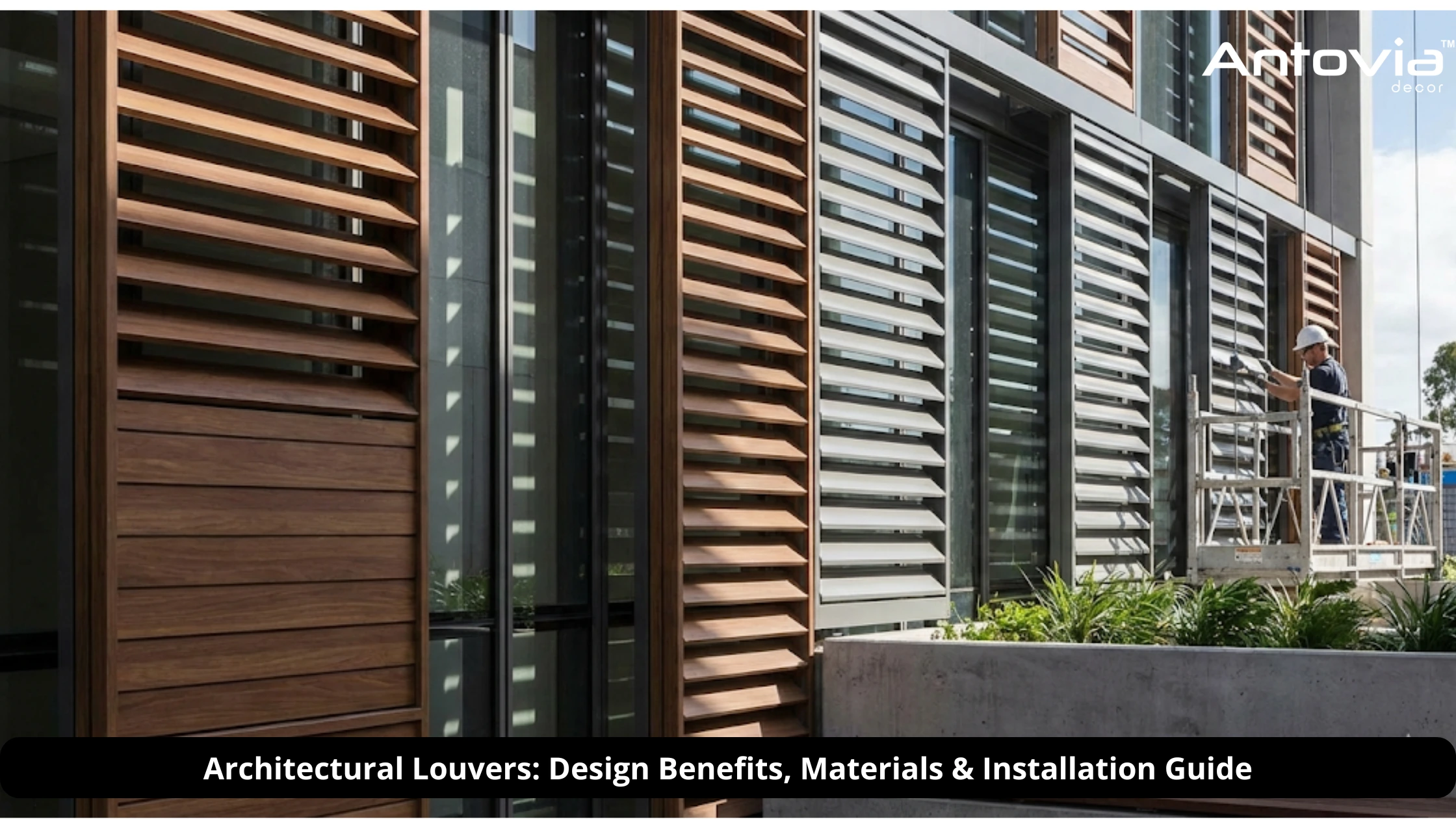
Modern buildings are expected to do far more than look good. They must control heat, manage glare, support ventilation, reduce energy consumption, and still maintain a strong architectural identity. Yet many projects struggle with overheating, uncomfortable interiors, and rising operational costs—not because of poor design intent, but because facade performance was addressed too late.
This is where architectural louvers become critical. When specified correctly, they act as a passive environmental control system. When treated as a decorative afterthought, they often fail—both visually and functionally.
This guide is written for architects, facade consultants, builders, and developers who want clarity instead of confusion. It explains what architectural louvers actually do, their real design and performance benefits, material choices that last, and installation practices that determine long-term success.
What Are Architectural Louvers in Modern Buildings?
Architectural louvers are fixed or operable slatted elements designed to regulate sunlight, airflow, heat, and privacy within a building. Unlike purely decorative fins, architectural louver systems are functional facade components that directly influence how a building performs throughout the day.
In modern buildings, louvers are used to:
- Reduce direct solar heat gain
- Control glare without blocking daylight
- Enable natural ventilation
- Create visual depth and facade rhythm
Louvers can be installed internally or externally, but exterior architectural louvers deliver the highest performance impact because they intercept heat and sunlight before it enters the building envelope.
The most common mistake projects make is treating louvers as accessories. In reality, they are part of the building’s environmental strategy. When integrated early into facade planning, louvers reduce cooling loads, improve occupant comfort, and extend facade lifespan.
Why Architectural Louvers Are More Than a Design Trend
At first glance, louvers appear to be a stylistic feature of contemporary architecture. In practice, their increasing use is driven by necessity rather than aesthetics.
As glass facades became more common, buildings started facing:
- Excessive heat gain
- Increased HVAC dependency
- Glare-related discomfort near windows
Louvers emerged as a practical response to these challenges. Instead of reducing glazing or relying entirely on mechanical systems, architects began using louver design for buildings to control environmental conditions passively.
Today, louvers are no longer optional in many commercial projects. They are specified early because once glazing ratios and orientations are fixed, correcting heat and glare issues becomes expensive—or impossible.
Design Benefits of Architectural Louvers for Building Facades
Well-designed building facade louvers deliver multiple performance and design benefits.
Solar Shading and Glare Reduction
Louvers block harsh, direct sunlight while allowing diffused daylight to enter. This improves visual comfort and reduces glare on screens and work surfaces—especially in office environments.
Improved Thermal Comfort
By limiting solar heat gain, louvers help maintain more stable indoor temperatures. This is particularly important for glass-heavy facades exposed to intense sun.
Visual Depth and Architectural Expression
Louvers add shadow play, rhythm, and depth to elevations. Flat facades gain character without relying on heavy materials or excessive articulation.
Privacy Without Blocking Airflow
Louvers allow visual screening while maintaining openness and ventilation. This balance is difficult to achieve with solid shading systems.
In real projects, louver performance depends less on profile shape and more on orientation, spacing, and angle. This is where many designs succeed on drawings but fail on site.
How Architectural Louvers Improve Energy Efficiency & Ventilation
One of the strongest reasons architects specify solar shading louvers is energy performance.
By reducing direct solar exposure:
- Cooling loads decrease
- HVAC systems operate more efficiently
- Energy consumption reduces over time
In buildings designed for natural or mixed-mode ventilation, ventilation louvers for buildings support airflow by enabling cross ventilation and the stack effect.
Louvers are most effective when coordinated with:
- Building orientation
- Glazing performance
- Window placement
Used correctly, louvers become a passive climate-control system rather than an added expense.
Popular Materials Used for Architectural Louvers
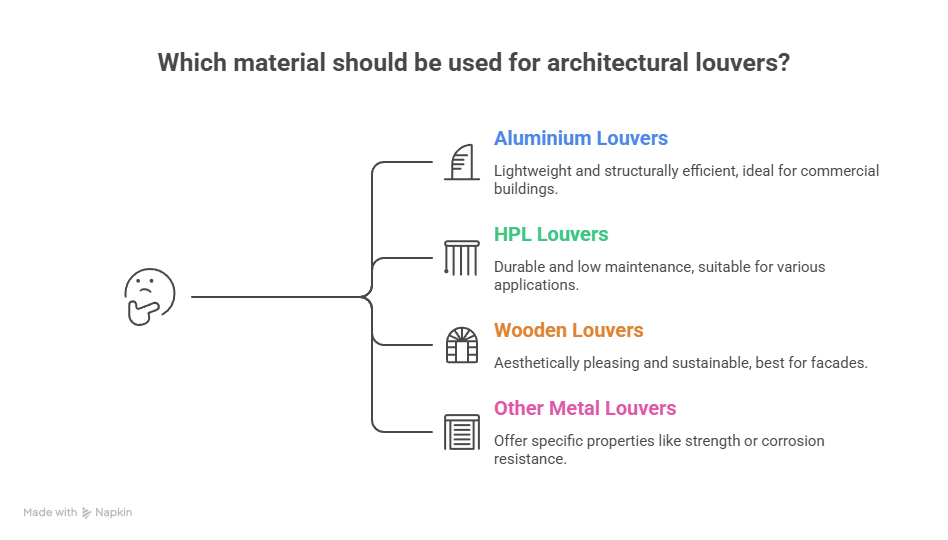
Material selection has a direct impact on durability, maintenance, and lifecycle cost. Choosing based only on appearance or price often leads to early failures.
Aluminium Louvers
Aluminium louvers are among the most commonly specified options.
- Lightweight and structurally efficient
- Excellent corrosion resistance
- Suitable for large spans and high-rise buildings
- Low maintenance
They are ideal for commercial buildings where consistency and long-term performance are priorities.
HPL Louvers
HPL louvers are increasingly used for exterior applications.
- Dense, solid structure
- High UV and weather resistance
- Available in woodgrain and contemporary finishes
- Minimal fading in harsh climates
HPL louvers are particularly suitable where a natural aesthetic is required without the maintenance burden of real wood.
Wooden Louvers for Facades
Wooden louvers provide warmth and visual richness.
- Best for covered or semi-exterior areas
- Require regular sealing and maintenance
- Less suitable for fully exposed facades
Other Metal Louvers
Steel or hybrid systems are typically used in industrial or utility-focused projects and require robust corrosion protection.
Material choice is not just a design decision—it determines how often the facade will need repair, repainting, or replacement.
Architectural Louvers Material Comparison
| Material Type | Key Advantages | Limitations | Best Use Cases |
| Aluminium Louvers | Lightweight, corrosion resistant, low maintenance, suitable for large spans | Can feel industrial if not finished well | Commercial buildings, offices, high-rise facades |
| HPL Louvers | High UV resistance, solid structure, natural finishes, color stability | Slightly higher initial cost than aluminium | Exterior facades, premium commercial projects |
| Wooden Louvers | Warm, natural appearance, strong visual appeal | High maintenance, limited exterior durability | Covered areas, semi-exterior applications |
| Steel / Metal Louvers | High strength, industrial durability | Requires corrosion protection, heavier systems | Industrial and utility-focused projects |
Vertical vs Horizontal Louvers: Design & Performance Differences
Orientation significantly affects how louvers perform.
Vertical Louvers
- Effective for east and west-facing facades
- Control low-angle morning and evening sun
- Offer better privacy control
Horizontal Louvers
- Ideal for south-facing facades
- Provide consistent solar shading
- Common in office and institutional buildings
Choosing orientation purely for aesthetics often leads to poor shading performance. Sun path analysis should always guide the decision.
Vertical vs Horizontal Architectural Louvers
| Criteria | Vertical Louvers | Horizontal Louvers |
| Best Facade Orientation | East & West | South-facing |
| Sun Control | Low-angle morning and evening sun | High-angle midday sun |
| Privacy Control | Strong | Moderate |
| Visual Effect | Vertical rhythm, strong facade articulation | Clean horizontal lines |
| Common Applications | Offices, hospitals, mixed-use buildings | Corporate offices, institutional buildings |
Installation Guide for Architectural Louvers
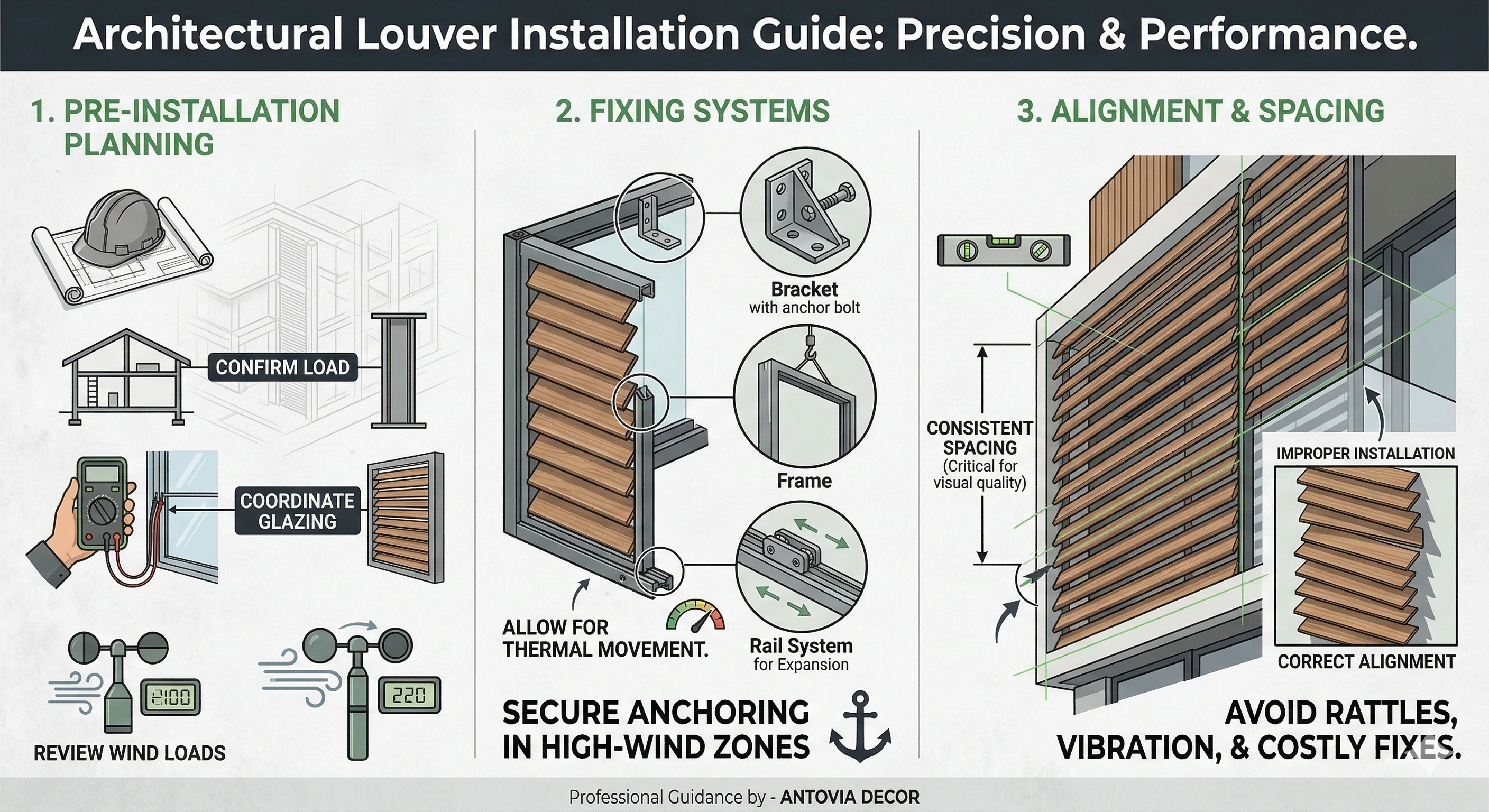
Even the best-designed louver system can fail if installation is poorly executed.
Pre-Installation Planning
- Confirm structural load capacity
- Coordinate with glazing and facade systems
- Review wind load calculations
Fixing Systems
- Use brackets, frames, or rail systems
- Allow for thermal expansion and movement
- Ensure secure anchoring in high-wind zones
Alignment and Spacing
- Consistent spacing is critical for visual quality
- Poor alignment creates uneven shadows and visual noise
Improper facade louver installation often results in rattling, vibration, or misalignment—issues that become visible only after occupancy. Fixing them later is costly.
Architectural Louvers for Indian Climate Conditions
India’s climate places extreme demands on facade systems.
Key challenges include:
- Intense heat and prolonged UV exposure
- Heavy monsoon rainfall
- High humidity in coastal regions
- Pollution and dust accumulation in urban areas
Exterior architectural louvers must be weather resistant, dimensionally stable, and corrosion resistant. Aluminium and HPL louvers perform well across Indian climates when specified correctly.
In coastal cities, corrosion resistance becomes critical. In high-temperature regions, UV stability and color retention matter far more than initial appearance.
Where Architectural Louvers Are Commonly Used
Architectural louvers are widely specified in:
- Office buildings and IT parks
- Airports and transportation hubs
- Hospitals and educational institutions
- Commercial complexes
- Premium residential projects
In many commercial developments, louvers are no longer optional—they are part of responsible facade design.
Common Design & Specification Mistakes to Avoid
Despite good intentions, many projects face issues due to:
- Treating louvers as purely decorative
- Ignoring sun orientation and wind loads
- Choosing materials based only on cost
- Poor coordination between facade and structure teams
- Confusing louvers with fins or sun breakers
Understanding the difference between louvers and fins helps avoid performance gaps that only become visible after the building is occupied.
How Architects Should Decide If Louvers Are Right for Their Project
Louvers are not a universal solution. They work best when:
- Facades have significant glazing
- Solar exposure is high
- Energy efficiency targets are important
- Long-term maintenance budgets are considered
If shading, ventilation, and visual comfort are critical to the project, architectural louvers are usually worth the investment.
Are Architectural Louvers Worth the Investment?
For most commercial and institutional buildings, the answer is yes.
Well-designed custom architectural louvers:
- Reduce long-term energy costs
- Improve indoor comfort
- Enhance facade durability
- Strengthen architectural identity
When evaluated over the building’s lifecycle, louvers deliver value far beyond their initial cost.
Why Architects Choose Architectural Louvers from Antovia Decor
When architectural louvers are specified for exterior facades, long-term performance matters as much as design intent. Antovia Decor focuses on developing architectural louver systems that are engineered for real-world conditions rather than short-term visual impact. Their louvers are designed to handle intense sun exposure, heavy monsoons, and urban pollution—challenges that commonly affect facade longevity in Indian climates.
Architects prefer Antovia Decor for its consistent material quality, dimensional accuracy, and finishes that remain stable over time. With a strong understanding of modern facade requirements, the brand supports projects where durability, clean detailing, and reliable execution are essential. For commercial and institutional buildings, Antovia Decor’s architectural louvers offer a balanced combination of performance, design flexibility, and long-term value.
Final Verdict: Why Architectural Louvers Matter in Modern Facade Design
Architectural louvers are no longer optional design elements—they are performance-driven facade systems. When designed, specified, and installed correctly, they reduce heat, improve ventilation, lower energy consumption, and add architectural depth without compromising comfort.
The difference between success and failure lies in early planning, correct material selection, and professional installation. For modern buildings facing demanding climate and energy expectations, architectural louvers are a smart, future-ready investment.
Frequently Asked Questions (FAQ)
1) What are architectural louvers used for?
Architectural louvers control sunlight, heat, glare, airflow, and privacy while enhancing facade aesthetics.
2) Which material is best for architectural louvers?
Aluminium and HPL are among the best materials for exterior use due to durability, weather resistance, and low maintenance.
3) Are architectural louvers suitable for exterior facades?
Yes. Exterior louvers are designed to handle sun exposure, wind loads, and weather when specified correctly.
4) How are architectural louvers installed?
Louvers are installed using structural brackets or framing systems that allow stability and thermal movement.
5) Do louvers help reduce heat and glare?
Yes. Properly designed louvers significantly reduce solar heat gain and glare, improving occupant comfort.


