Difference Between HPL, Compact Laminate & Regular Laminates
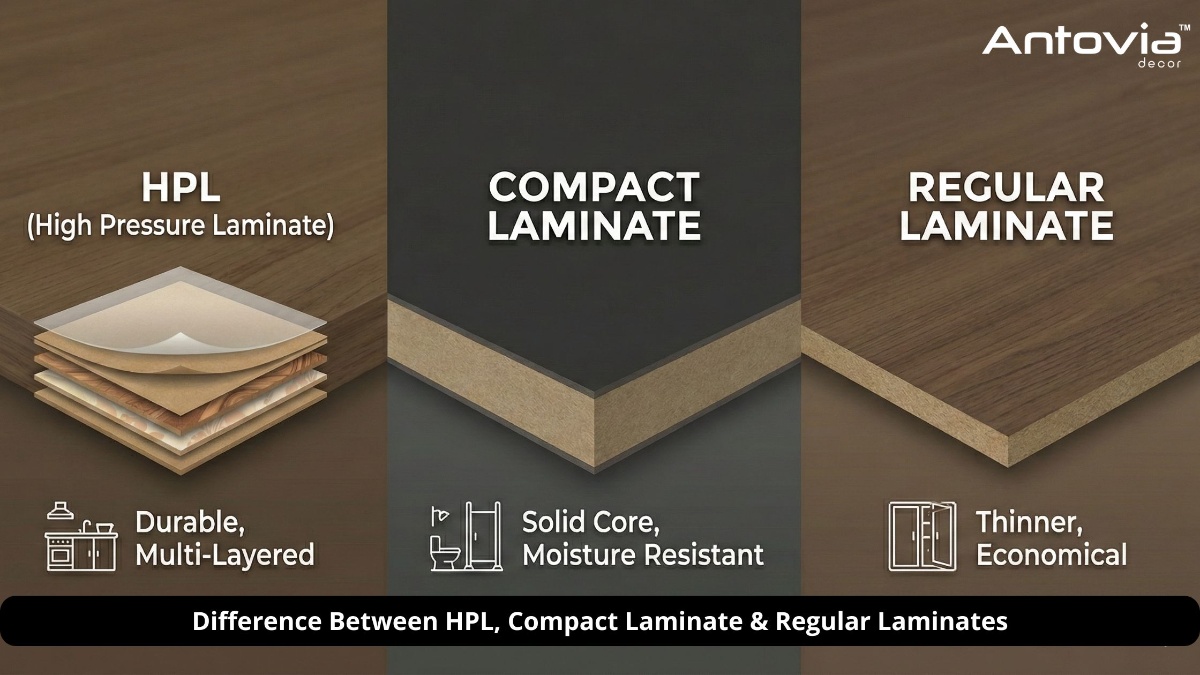
One of the greatest decisions one has to make when undertaking any interior or exterior project is the choice of the appropriate surface material. Laminates are now used in homes and offices, retail and hospitality areas because of its ability to withstand the design process as well as cost efficiency and durability. Not all laminates do however. Understanding the difference between HPL, compact laminate, and regular laminates helps architects, designers, and homeowners make informed decisions that impact longevity, aesthetics, and maintenance.
This guide will give a detailed description of each of the laminates, performance comparisons of the two laminates, and aid you to select the appropriate laminate to use in both residential and commercial building.
What Are Laminates and Why Are They Widely Used?
Laminates are fabricated decorative surfaces, which are produced by gluing kraft paper and decorative sheet layers under pressure and temperature. Resins are added to these layers to increase the strength, stability and against resistance to everyday wear.
Laminates are typically utilized in:
- Furniture and cabinetry
- Partitions and wall cladding.
- Flooring solutions
- Worktops and countertops
- Internal and external decorative surfaces.
They are made out of natural material replicas such as wood, stone and marble and they gain popularity because they are more consistent and easier to maintain.
What Is HPL (High Pressure Laminate)?
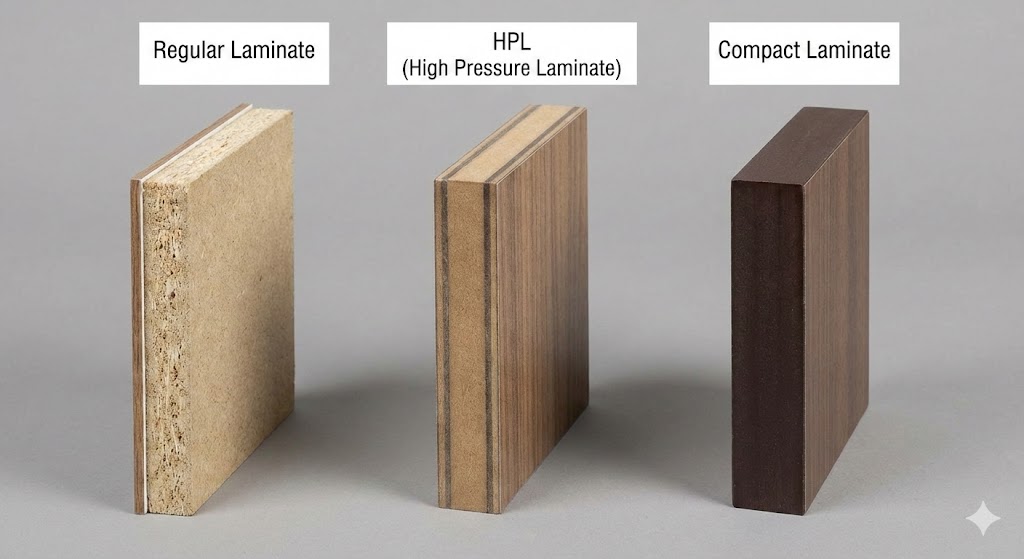
HPL is manufactured by pressing multiple layers of kraft paper and decorative paper under high pressure and high temperature. This is done to form a dense and hard surface which can be used in interior and exterior applications.
HPL is widely used because it balances aesthetics and performance. It is very hard, resilient to impacts, and easy to design.
Key features of HPL:
- High scratches and abrasion resistance.
- Constant performance in changing temperatures.
- Large assortment of textures and finishes.
- Recessed into the small surfaces vertically and horizontally.
HPL is commonly used in wall panels, furniture surfaces, facades, and areas that experience regular usage but do not require structural support.
What Is Compact Laminate?
A compact laminate is a high-density version of HPL with a solid core. It is produced in various layers of kraft paper that is subjected to very high pressure levels to produce a stiff self-supporting panel.
Unlike standard laminates, compact laminate does not require a substrate in many applications, making it ideal for demanding environments.
Key characteristics of compact laminate:
- Very high structural strength.
- Very moisture and humidity resistant.
- Applicable to heavy-duty applications.
- Prolonged maintenance with low maintenance.
Compact laminate is widely used for partitions, lockers, laboratory furniture, exterior cladding, and compact laminate worktop applications where durability is critical.
What Are Regular Laminates?
Low-pressure laminates also known as regular laminates are thinner decorative sheets and need to be supported with a substrate, usually MDF or plywood. These laminates are mostly applied in residential interiors that do not have high exposure to moisture and impact.
They are a cheap option to use to decorate but not heavy or exterior.
Usual characteristics of normal laminates:
- Surface solution that is cost-effective.
- Large design and color selections.
- Applicable in low-impact areas.
- Minor resistance to moisture and heat.
Wardrobes, cabinets and decorative furniture surfaces are often finished with regular laminates.
Key Differences Between HPL, Compact Laminate & Regular Laminates
The knowledge of the differences in the types of laminate assists in choosing the proper material to be used in particular tasks.
Manufacturing process
- HPL: High pressure and temperature bonding
- Compact laminate: Extremely high pressure with solid core
- Thick laminates: Low pressure laminations.
Thickness and strength
- HPL: Medium thickness with strong surface durability
- Compact laminate: Thick, dense, and self-supporting
- Regular laminates: Thin and decorative
Moisture resistance
- HPL: Moderate to high resistance
- Compact laminate: Excellent moisture resistance
- Regular laminates: Limited resistance
Application suitability
- HPL: Interior and exterior surfaces
- Compact laminate: Heavy-duty and high-moisture areas
- Regular laminates: Dry interior spaces
Comparison Table: HPL vs Compact Laminate vs Regular Laminates
|
Feature |
HPL |
Compact Laminate |
Regular Laminates |
|
Manufacturing Process |
High pressure bonding of kraft and décor layers |
Extremely high pressure with solid core construction |
Low pressure bonding |
|
Thickness & Density |
Medium thickness, surface-focused strength |
Thick, dense, and self-supporting |
Thin decorative layer |
|
Moisture Resistance |
Good moisture resistance |
Excellent, suitable for wet areas |
Limited moisture resistance |
|
Structural Strength |
Requires substrate support |
Self-supporting and load-bearing |
Requires substrate support |
|
Suitable Applications |
Wall panels, furniture, facades |
Partitions, lockers, compact laminate worktop, washrooms |
Cabinets, wardrobes, decorative interiors |
|
Flooring Compatibility |
Used in selected flooring systems |
Suitable for heavy-duty areas |
Used in residential laminate flooring |
|
Durability Level |
High |
Very high |
Moderate |
|
Cost Range |
Mid-range |
Premium |
Budget-friendly |
HPL vs Compact Laminate: Which One Should You Choose?
HPL is ideal when you need durability combined with design flexibility. It is ideal in wall cladding, furniture and facade whereby there is a substrate.
Compact laminate is the better choice for high-traffic or moisture-prone environments. It is very strong, and it is applicable in washrooms, commercial kitchen, outdoor installation, where performance is more important than thickness.
Compact Laminate vs Regular Laminates: Performance Comparison
Compact laminate outperforms regular laminates in almost every technical aspect. It is better resistant to moisture, impact and has longer life. Ordinary laminates are still an affordable alternative of decorative interior surfaces with restricted usage.
For areas exposed to water, heat, or frequent cleaning, compact laminate provides long-term value despite a higher initial cost.
HPL vs Regular Laminates: Design and Durability
HPL offers better surface strength and longer life compared to regular laminates. It also offers superior finishes and textures which do not fade away with time. Normal laminates are susceptible to fading or disintegration in places of high traffic.
For projects where durability and finish consistency are essential, HPL delivers better overall performance.
Which Laminate Is Best for Flooring Applications?
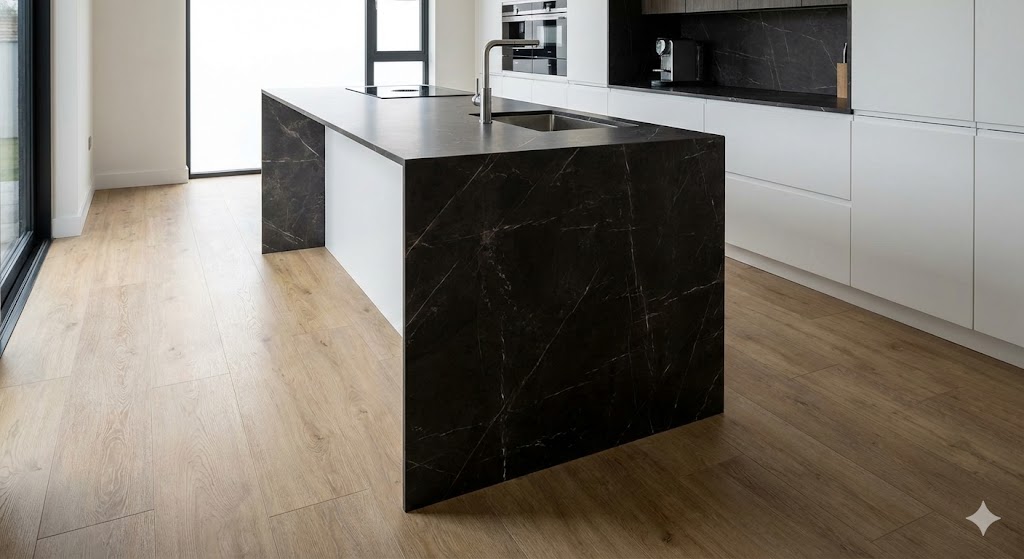
Laminate flooring has become a popular alternative to natural materials due to its cost efficiency and visual appeal. The best laminate flooring option depends on the environment and usage level.
Types of laminate flooring applications include:
- Laminate flooring for living rooms and bedrooms
- Waterproof laminate flooring for moisture-prone areas
- Bathroom laminate flooring with enhanced moisture resistance
- Kitchen laminate flooring designed to handle spills and heat
High-performance laminates are also used in commercial laminate flooring where durability and ease of maintenance are critical.
Decorative Flooring and Surface Finishes
The modern laminates have a great variety of finishes that imitate the premium material.
Popular choices include:
- High gloss laminate flooring for contemporary interiors
- Marble laminate flooring for a luxurious appearance
- Stone effect laminate flooring for natural aesthetics
These finishes offer the appearance of natural materials and are more consistent and require less maintenance.
Which Laminate Works Best for Commercial Spaces?
Business areas require materials that are durable, clean regularly and have long working hours. Compact laminate and HPL are commonly preferred for offices, malls, healthcare facilities, and educational institutions.
They are resistant to wear, moisture and impact making them applicable in strenuous commercial uses where performance and safety are the main concerns.
How to Choose the Right Laminate for Your Project?
The choice of the laminate is dependent on a number of factors:
- Area of application
- Contact with moisture and heat.
- Intensity of level and usage of traffic.
- Maintenance expectations (long-term and budget).
- Desired aesthetic finish
Knowledge of these parameters will make sure that the chosen laminate will be valuable in terms of functionality as well as aesthetics.
Common Myths About Laminates
Among the greatest misunderstandings is that any laminates perform at the same level. As a matter of fact, laminates are differentiated by a lot of factors in terms of the material composition, manufacturing pressure, and the core structure. Thickness, resin quality, and layering are some of the factors that have a direct effect on durability and moisture resistance and lifespan. Another widespread myth is that compact laminate is suitable only for industrial or laboratory environments. Nowadays it is also applied in the residential high-end residential construction in kitchens, bathrooms, and highly populated spaces because it is strong and it does not get wet.
There are also assumptions that laminates are not capable of providing a high quality appearance. The laminates of today can copy natural materials such as marble and stone in great details. To do the right decision one has to know the application requirements and not base on price or appearance.
Why Quality Laminates Matter in Long-Term Projects
The laminates used in quality are important in the success of any interior or exterior realization in the long term. High grade laminates give more resistance to wear, moisture and day to day impact hence saving a lot of maintenance and replacement expenditure in the long run. In places where there is moisture, heat or high traffic, the correct laminate will guarantee uniform functions as well as aesthetic permanence.
Certified standards of manufacturing guarantee that the thickness of the product is uniform, is bonded and that the surface is durable, which makes the products safe and durable. Sustainable construction can also be achieved through selecting quality laminates, where the wastes of the material will be reduced and the replacement will be limited. This is because in the long run premium laminates offer more value as they are a combination of durability, appearance and reliable performance.
Why Choose Antovia Decor for Premium Laminate Solutions?
In Antovia Decor, laminates are to be planned according to the changing requirements of contemporary interior and exterior architecture. From HPL surfaces to high-performance compact laminate panels, every product is manufactured with a focus on durability, design consistency, and long-term value.
Antovia Decor offers laminate solutions suitable for residential and commercial spaces, including kitchen laminate flooring, bathroom laminate flooring, and commercial laminate flooring applications. With a wide selection of finishes such as high gloss laminate flooring, marble laminate flooring, and stone effect laminate flooring, Antovia Decor ensures design flexibility without compromising performance. The brand offers durable laminate solutions to projects that require both the beauty and the strength supported by industry experience and quality standards.
Final Thoughts: Making the Right Laminate Choice
Understanding the difference between HPL, compact laminate, and regular laminates helps you select the right material for your project. The types are used for a particular purpose and the most appropriate type is based on the application requirements, durability and design objectives.
A benchmarking approach to performance, aesthetics and long-term value provides the confidence to be able to select a laminate solution that not only improves functionality but also style as well.
FAQs
1. What is the main difference between HPL and compact laminate?
HPL is a high-pressure decorative surface that requires a substrate, while compact laminate has a solid core and can be used as a self-supporting panel in heavy-duty applications.
2. Are laminates suitable for kitchens and bathrooms?
Yes, specially designed laminates such as compact laminate and waterproof laminate flooring are suitable for kitchens and bathrooms due to their moisture resistance.
3. What is the recommended laminate to be used as flooring?
The best laminate flooring depends on usage. Waterproof laminate flooring is ideal for moisture-prone areas, while high gloss laminate flooring works well for modern living spaces.
4. Can compact laminate be used in residential projects?
Absolutely. Compact laminate is increasingly used in premium residential interiors, including kitchen worktops, bathroom partitions, and wall panels.
5. Do laminates require high maintenance?
No, laminates are surfaces with low-maintenance. They only require regular cleaning to ensure their appearance and performance in the long run.


